By Taiwo Adediran
“They were four on the motorcycle approaching Okolowo from the Mandala axis along Ilorin-Igbeti road. It was early at the dawn. I had signalled to them to stop, but they ignored. Just as I tried to stress my concern, the motorcycle rider swerved towards where I was standing by the road side and almost rammed into me. Missing by a whisker, he uttered some abusive words and accelerated the motorcycle. Just within seconds, we heard a loud crash. There was no doubt about it; we knew they had crashed into the collapsed bridge.”
Those were the words of Shehu, one of the local guards employed by the Government to secure the collapsed Moro Bridge, along Ilorin-Igbeti road in Kwara State. The guards were to secure properties around and importantly, alert motorists to the danger ahead while redirecting them to follow the alternative route. The mishap narrated by Shehu was a fatal one which claimed the lives of two, while others sustained critical injuries. It was not the first since the latest collapse of the old Moro Bridge in the wee hours of Thursday, April 30, 2026. A young man, later buried by the river bank, had slipped into the river and got swept away while attempting to cross. A man carrying log of woods had earlier plunged into the abyss, sustaining serious injuries. A business woman lost bags of rice worth millions of naira as the vehicle conveying the goods fell on its side, emptying its content into the river. The story had always been the same whenever the Bailey bridge collapses, a development that seems to have happened for God-knows how many times.
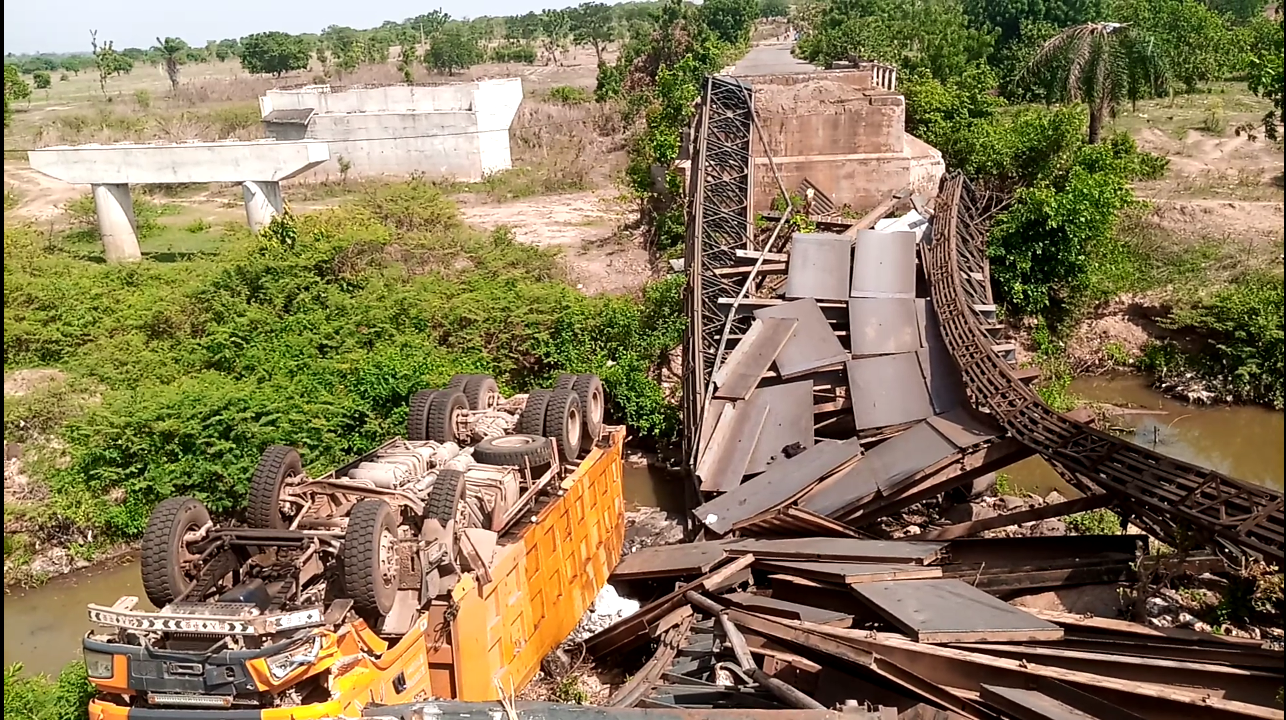
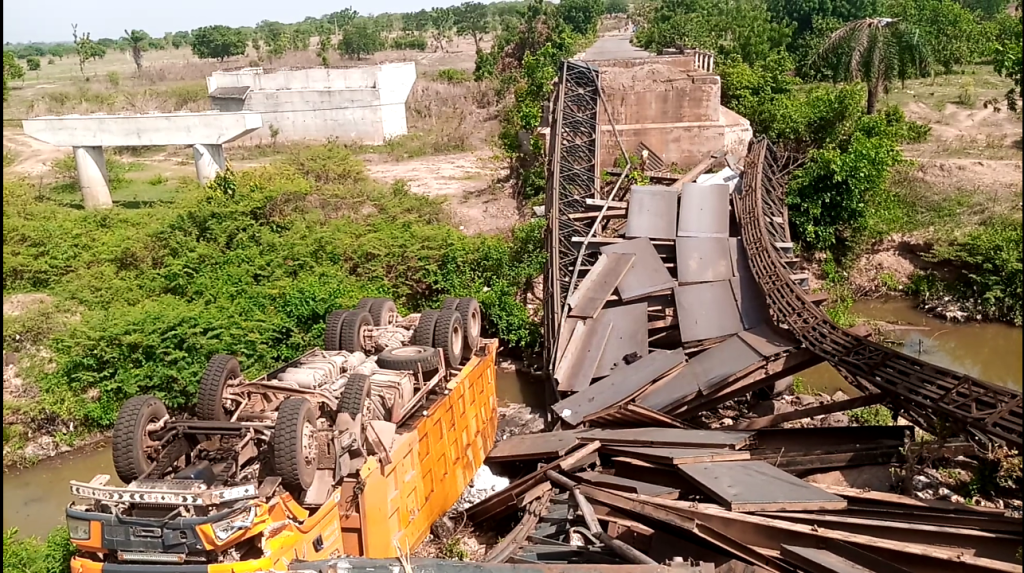
While the local vigilante man narrated the gory incidents, this reporter looked around. Littered all over, down the collapsed bridge were bits of metal and the general mess left from the ruin. On the collapsed bridge debris were fragments from cars and motorcycles, scattered luggage, foot wears of accident victims and a blood stained rock – perhaps that of a victim said to have smashed his head against the rock as he descended.
At one side of the bridge was an upturned truck belonging to a construction company. The weak bridge collapsed under the heavy weight of the fully-loaded truck, disrupting movement on a major Oyo-Kwara interstate road. Barricade tapes were seen tied about 100metres away at both ends of the bridge to indicate restriction and prevent further accidents. To the left stands an abandoned bridge project, already covered with patch of shrubs. To the far right is the emergency diversion for motorists and pedestrians.

The Moro Bridge is a bailey bridge along the Ilorin-Igbeti road. It is a narrow, pre-fabricated steel truss bridge built during the colonial era. Not far from the Okolowo Ilorin-Jebba express way, the bridge is on a commercial route, linking Kwara and Oyo states. For decades, the road has served business travelers who move from the northern part of Oyo state to Kwara and beyond to buy and sell.
The Ilorin-Igbeti road serves more than 20 communities along the axis, including the Medium Correctional Centre, at Mandala, along the border part of Kwara State. The communities include Mandala, Sosoki, Edugbede, Iyana Alakuko, Alamba, Alapa, Polofo, Onire, Ode, Papase-dogo, Igbeti, Kisi, Kaiama, Okuta, Ilesa-Baruba, Igboho and others. These communities are homes to farmers who cultivate the farmlands along the route. This underscores its economic significance to the people.
Despite the importance, the Moro Bridge has suffered decades of neglects by the federal government. After multiple structural failures and collapses, the federal government in 2017 approved the construction of a new Moro bridge. It was awarded alongside the Ohan Bridge – a similar Bailey bridge – an hour drive along the same road and suffering the same fate.
An Abyss of Public Fund
After several years in use, the federal government awarded the rehabilitation of Ohan and Moro Bridges to the contractor Messrs. Bilijoe + Berger Nigeria Limited on March 27, 2017, with initial contract sum of N865,019,925.00.
The Ministry of Works, in its response to a Freedom of Information, FOI, letter, requesting for details regarding the project, confirmed the contract award date, the initial sum and the contractor. The letter signed by the Acting Federal Controller of Works, Kwara State, Engr. I.A Fabamise, put the completion rate of the project at 41.99%. It however, failed to state details of how much has so far been released to the contractor, as well as why the project has been stalled for almost a decade since it was awarded.

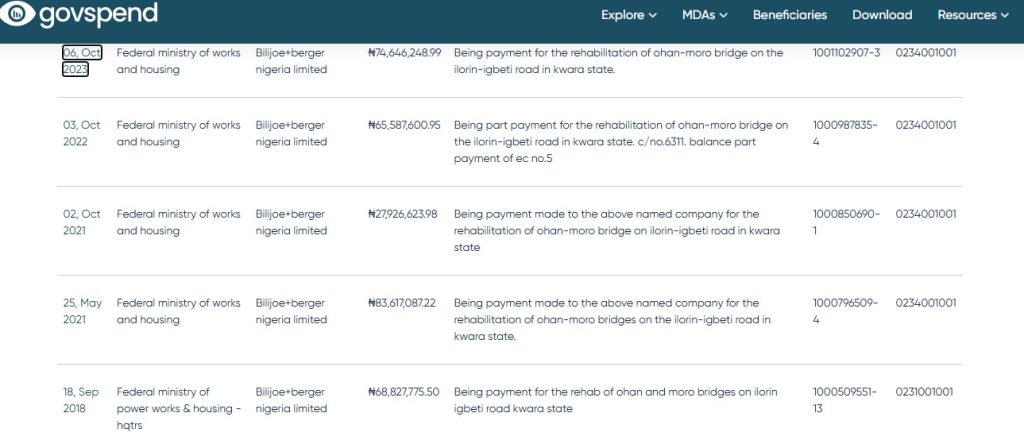
Nonetheless, a probe on public contract tracking app, Govspend, revealed that fund had been released to the contractor, Messrs. Bilijoe + Berger Nigeria Limited, a couple of times after the take-off mobilization fund. On September 18, 2018, the Federal Ministry of Power, Works and Housing, where the contract is domiciled, released the sum of N68, 827, 775, 50 for the rehabilitation of Ohan and Moro bridge on the Ilorin-Igbeti road, Kwara State. On May 25, 2021, the Federal Ministry of Works and Housing, released N83,617,087.22 to the contractor. On October 02, 2021, the same contractor received N27,926,623.98 from government coffers for the same purpose. A year after, precisely October 03, 2022, the sum of N65,587,600.95 was released to the contractor. On October 06, 2023, the government again released another tranche of N74,646,248.99 for the same rehabilitation of Ohan and Moro bridge. Months before the last release of funds, specifically March 20, 2023, the federal government, through the Ministry of Works and Housing released N25,097,720.00 for the emergency repair works on Ohan bailey bridge. In spite of this huge sum, only the piers of the bridge has been built without the piers caps, while the old Bailey bridge remains the only route for commuters.
The Endless Suffering
During this reporter’s visit to the bridge, vehicles were plying the diversion by diving down into the river and climbing up the steep pathway, a move that has turned out to be herculean and dangerous especially for heavily loaded or heavy-duty vehicles. On several occasions, passengers disembark from the vehicles to reduce the load and ease the passage. They also resort to pushing the vehicles when it screeches endlessly while trying to climb uphill. Some individuals have relocated to the area to engage in brisk business by helping to push vehicles, clear paths and carry loads.
Video: A loaded vehicle struggles to pass through the improvised road diversion, following the collapse of the Moro Bridge. https://x.com/adedirantai/status/2069315207592075432/video/1
A trader at Moro community, who declined to disclose her name, rued the effect of the bridge collapse on businesses. She noted that it has made doing business more difficult along the corridor.
“The situation has affected our businesses, because we haven’t been able to convey goods. If you have to, you need to charter a tricycle to bring your goods from Oja-Tuntun, (New Market). The tricycle operators will offload it here. Then you find labourers to help you carry the goods across the river, to the other side where you board another tricycle to your community. That’s additional expenses.”
According to her, the development accordingly impacts prices of goods and services as traders have to factor it to stay in business.
Another businesswoman, Madam Modupe Adebisi, who was waiting to board a vehicle to Kisi, said they now pay more for transport fare than they did before the collapse of the bridge.
“When we were still managing to wade across the river, we only pay to get our goods and the vehicles to cross. But sometimes we pay more. Now that there’s been regular downpour, vehicles can no longer cross the river. It’ll be suicidal for anyone to try.
“It’s either you pay hugely for some young men at the spot to help you, so that you can get your goods across or you travel through the alternative route, but that also costs more because it’s a longer route. Imagine having to go to Ogbomoso first, just to bypass this place,” she said.

A resident close to the river bank, Rasheedat Olowookere, said although, the diversion has caused no security breach, the vehicle movement on the busy road poses some safety concerns and is felt late into the night as well as early in the morning.
“We don’t have any problem with the diversion. The only thing is that we are now more concerned about our safety because vehicles including trucks now move closer to the residential buildings. We have to take extra precaution especially with the kids.”
According to another Mandala inhabitant who identified herself as Ayobami, residents in the affected communities also suffer the adverse effect when urgent medical attention is required.
“Although, we’ve not had such situation now, we have had it in the past. Imagine the challenges we face while trying to get women in child labour to medical facility. There are situations when the cases are complicated and the patients need to be rushed to a medical facility. How do we manage such situation?” she asked.
A farmer, Lukman Abdulrauf, said the development has negatively impacted their work and even rendered some farmers helpless. According to him, it’s been difficult getting to the farm and also transporting the harvests to the market.
“This bridge has caused a lot of challenges for us as farmers. To get to the farm and get back has been difficult even if you are mobile, how much more when you have farm products to transport. For instance, how do we convey cassava? Those who want to buy, where would they pass? How do we get labourers and tractor to the farm? In fact, as we speak, some of our people don’t even go to the farm regularly again.
“That is to tell you the urgency required to fix this bridge for us. Unfortunately, the government is yet to do anything tangible so far. All they care about now is how to be re-elected into office in 2027,” he said.
Deadly voyage
After the collapse of the Moro bridge in April, the diversion served as an improvised route to the other side. But as the rain peaked gradually, it became a road paved with peril. For those whose survival depended on making the trip, it was absolute flirtation with death. Pedestrians hold on to the wreckage of the steel truss, taking one step after the other as they crossed, with the surging water echoing beneath their feet.
Video: Residents taking risk crossing the collapsed bridge
https://twitter.com/NigeriaStories/status/2056657720023920924/video/1
A visibly frustrated community leader, Sulaiman Adisa, expressed concern over the lingering bridge collapse. He stated that the incident always make day to day activities difficult for residents. The agitated community leader condemned the government’s insensitive disposition towards the suffering of the people.
“Can you see what we are going through in a community where we also pay tax and vote? This is the harrowing experience we bore everyday, even during the Muslim Eid-el-Kabir celebration.
“The palliative that the state government is erecting is still pending and it’s doubtful that this will bring respite. We can stand here now because the downpour is still moderate. By the time the rain gets heavy, it will submerge this pedestrian bridge that we are managing. We won’t even be able to come close to this place. To now say you want to place a container here, it just won’t work at all.
“Once the rain starts, no one can cross except those who know how to swim very well. A car tried it recently after a heavy rain. It got submerged and all the passengers had to climb on the car roof to stay afloat, stuck in the middle of the river. Divers now swam there with kegs tied to ropes. They started to get the passengers on the keg and draw them to safety. If not, we would have had additions to the ones already swept away by this river.
“During such period, if you want to cross with a motorcycle, you have to pay. The swimmers pass two planks through the motorcycle. Then, four of them will hold the planks at each end to carry it across the river,” he said.

He lamented the loss by residents due to the precarious state of the river. “A boy in his 20s got swept away and we did not find him till after three days. That’s where we buried him at the river bank,” pointing to a grave meters away. “A car plunged into this ditch and was so damaged that it had to be sold in carcass at Oloje. A businessman had a trailer-load of rice washed off. Even during the Salah period, people lost their rams and fowls in the river. They will never forget the ugly incident.”
He noted that the community had lobbied successive governments and cried to top government officials several times, but to no avail as they keep promising with no positive outcome.
“They just keep promising and promising, without fulfilling it. The best we have seen are repair works carried out on the old bridges. It is really disturbing.”
A commercial driver, Alhaji Dauda, stated that the pedestrian bridge being used at the time was built by community effort and not the government. He expressed fear of a worsening situation when the rain starts to fall frequently.
“Vehicles are still able to cross because it’s been days since rain fell and the water has ebbed. Even at that, you can see how they struggle to climb. With the way he’s accelerating to climb up, it can spoil the gear of the car. If that happens, it’ll cost not less than N200,000 to repair it. If it’s the engine, it could cost up to N1m. We appeal to the government to come to our aid.
“Even farmers go through the same ordeal while transporting their farm produce. Once it rains, there’s no means to do that. It is quite frustrating that two major bridges are in this pathetic state. The other one is like an hour drive away from here, same condition,” he said.
Also speaking, the state chairman, Road Transport Employers Association of Nigeria (RTEAN) in Kwara State, Alhaji AbdulRahman Onikijipa, who spoke on behalf of transporters, decried the neglect of the bridge, a situation, he said has paralysed economic activities in the axis.
Onikijipa stated that, “If you know Kwara North very well especially Kaiama and Baruten, that’s the food basket of Kwara State. In Oyo, you have Saki, Kisi, Igbeti and other agrarian communities in Oke-Ogun. Their major work is farming, but it has suffered setback because of this bridges. Even, the alternative routes are in deplorable condition.
“At this time now, many of our people are not working. Some who took the risk are spending to repair because of the damages due to the bad roads.”
A top prison official, who spoke on condition of anonymity, disclosed that the situation disrupts judicial activities as the prison authorities at the correctional facility were sometimes hindered to convey suspects to court in Ilorin.

The Unending Wait
The state Government in a statement through the Press Secretary, Ministry of Works, Olajide Moyo Abolarin, says it is assisting to ease movement by creating an alternative route. It added that the federal government has assured that work will resume on the abandoned bridge project.
Efforts to hear from a top official of the contractor, Messrs. Bilijoe + Berger Nigeria Limited, met with brick wall as he referred this reporter back to the Federal Ministry of Works, with a snappy comment: “Go to the Works Ministry to get the details. It is their money, it is their project.” He then hung up the phone.
State officials working at the site denied knowledge as regards the circumstances surrounding the abandoned federal government project, but revealed that the ongoing palliative work was being funded by the Kwara State government.
Head of the engineers from the State Ministry of Works at the location, who preferred not to mention his name because he was not authorized to speak, disclosed that the temporary bridge called ‘palliative’ will serve the communities pending when the federal government finds a lasting solution to the predicament. He, however, could not tell how long it will take for the palliative to be concluded and declared ready for use.
Residents, transporters and commuters have, however, raised concerns over the viability of containers to construct the palliative. There are fears that the container may soon cave in under the weight of heavy vehicles or get submerged by flood when torrential rain starts in earnest. While the affected communities wait endlessly for an approximately 10-year old bridge contract to see the light of the day, promises remain broken, lives continue to be cut short, local commerce remains paralysed, and the tragic tale of the abandoned Moro Bridge continues to haunt.
This investigation was supported by the Budeshi Media/Mini Grant, an initiative of the Public and Private Development Centre (PPDC).