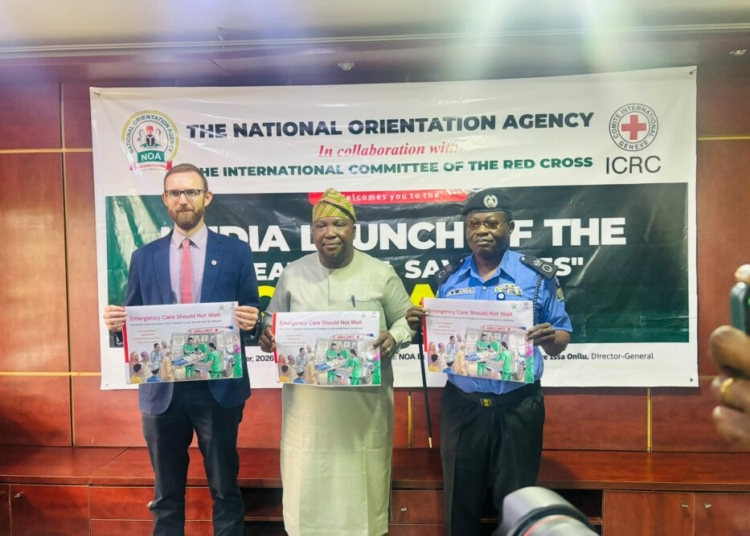
The National Orientation Agency (NOA) and the International Committee of the Red Cross (ICRC) have launched a nationwide campaign to ensure that victims of gunshot injuries receive immediate medical attention without unnecessary delays arising from police procedures or other administrative requirements.
The campaign, tagged:”Treat First. Save Lives,” seeks to strengthen public awareness and promote the implementation of the Compulsory Treatment and Care for Victims of Gunshot Wounds Act, 2017.
Declaring the campaign open on Thursday, the Director-General of NOA, Mallam Lanre Isa-Onilu, said it was designed to preserve human life during emergencies and remove misconceptions that prevent gunshot victims from accessing timely medical care.
Isa-Onilu, who was represented by the Director of Health and Social Care at NOA, Dr Ayoola Abiodun Olufemi, said gunshot injuries required urgent medical attention, warning that delays could have serious consequences.
“At such a critical moment, every delay can have serious consequences. Yet, over the years, misconceptions, fear of legal or police complications, and uncertainty about the responsibilities of hospitals and other stakeholders have sometimes created barriers to timely treatment,” he said.
He noted that the Compulsory Treatment and Care for Victims of Gunshot Wounds Act, 2017, provides a legal framework to address the challenge by requiring hospitals to provide immediate and adequate treatment to victims without insisting on police reports.
He said the law also prohibits hospitals from withholding emergency treatment because a victim could not produce a police report.
“The message of this campaign is therefore simple and unambiguous: treatment must come first. Saving a life must be the immediate priority,” he said.
The NOA director-general said ensuring compliance with the law was a shared responsibility involving hospitals, security agencies, healthcare professionals, members of the public and relevant institutions.
He urged members of the public to assist gunshot victims in accessing medical facilities rather than allow fear or misinformation to prevent them from offering help.
He also called on law enforcement officers to uphold the provisions of the law while carrying out their legitimate responsibilities, stressing that the protection of human life must remain paramount.
According to him, the law can only achieve its objectives when Nigerians understand its provisions, appreciate their responsibilities and are willing to act accordingly.
Also speaking, the Deputy Head of Delegation of the ICRC in Nigeria, James Matthews, said the campaign was aimed at strengthening public understanding of the 2017 Act and ensuring that victims of gunshot injuries could access life-saving treatment without unnecessary delays.
He said protecting access to healthcare was an important humanitarian priority for the organisation.
Matthews said although Nigeria had an appropriate legal framework, lack of awareness, fear and uncertainty about procedures surrounding gunshot injuries continued to pose challenges to its implementation.
He said the provisions of the law must be understood and translated into practical action by members of the public, healthcare professionals and security personnel.
“We believe that protecting access to healthcare is a shared responsibility. Citizens must be encouraged to help injured people reach medical facilities promptly. Healthcare providers must understand their obligations, while security personnel and relevant institutions have an important role in facilitating timely access to care.
“Sustained institutional cooperation is necessary to address the practical challenges associated with the implementation of the law,” he said.
In his goodwill message, the Inspector-General of Police, Tunji Disu, represented by the Director of Legal Services, CP Aremu Bamidele, said the treatment of gunshot victims was not merely a medical concern but also a fundamental human rights and public safety issue.
He said the right to life, as guaranteed under Section 33 of the 1999 Constitution, as amended, imposed an obligation on all state institutions to act in ways that preserve human life.
Bamidele said the Compulsory Treatment and Care for Victims of Gunshot Wounds Act, 2017, mandated hospitals and medical facilities across the country to provide immediate treatment to victims, whether or not they presented police reports.
He added that the law prohibited hospitals from making police reports a precondition for emergency medical care.
He reaffirmed the commitment of the Nigeria Police Force to implementing the law, saying officers had consistently been directed not to subject gunshot victims to harassment or delays in accessing treatment because of police procedures.
“We have consistently directed our officers that no victim of gunshot injuries shall be subjected to harassment, delay, or denial of medical care on account of police procedure. Saving lives must take precedence over paperwork, and protection of the victim remains the overriding priority,” he said.
He said the police would continue to collaborate with medical practitioners, civil society organisations and other stakeholders to ensure that no Nigerian died from preventable gunshot injuries because of fear, ignorance or bureaucratic delays.
Bamidele explained that the law was enacted in response to recurring cases in which hospitals and other officials refused to treat gunshot victims without police reports.
He warned that the Act prescribed sanctions for hospitals that refused to treat victims of gunshot injuries, including a fine of N500,000 or five years’ imprisonment